Withdrawal and replacement
Demonetizationedit
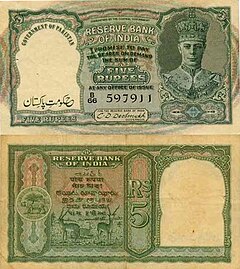
Demonetization is the act of stripping a currency unit of its status as legal tender. It occurs whenever there is a change of national currency: The current form or forms of money is or are pulled from circulation and retired, often to be replaced with new notes or coins. Sometimes, a country completely replaces the old currency with new currency.
The opposite of demonetization is remonetization, in which a form of payment is restored as legal tender.
Coins and banknotes may cease to be legal tender if new notes of the same currency replace them or if a new currency is introduced replacing the former one. Examples of this are:
- During Nazi occupation of Netherlands, 500 & 1000 guilders were demonetized, and after liberation 100 guilder was also demonetized. Anne Frank in her diary entry on March 19, 1943 notes:
Piet Lieftinck's measure of demonetizing 100 guilder was aimed at war profiteers.Thousand-guilder notes are being declared invalid. That'll be a blow to the black marketeers and others like them, but even more to people in hiding and anyone else with money that can't be accounted for. To turn in a thousand-guilder bill, you have to be able to state how you came by it and provide proof. They can still be used to pay taxes, but only until next week. The five-hundred notes will lapse at the same time. Gies & Co. still had some unaccounted-for thousand-guilder bills, which they used to pay their estimated taxes for the coming years, so everything seems to be above board.
- On October 6, 1944, 100 franc was demonetized. People having 100 francs were allowed to exchange up to 2000 francs per household for new banknotes. Banks added withdrawal limits and checking accounts were frozen.
- The United Kingdom, adopting decimal currency in place of pounds, shillings, and pence in 1971, Banknotes remained unchanged (except for the replacement of the 10 shilling note by the 50 pence coin). In 1968 and 1969 decimal coins which had precise equivalent values in the old currency (5p, 10p, 50p – 1, 2, and 10 shillings respectively) were introduced, while decimal coins with no precise equivalent (½p, 1p, 2p – equal to 1.2d (old pence), 2.4d, and 4.8d respectively) were introduced on 15 February 1971. The smallest and largest non-decimal circulating coins, the half penny and half crown, were withdrawn in 1969, and the other non-decimal coins with no precise equivalent in the new currency (1d, 3d) were withdrawn later in 1971. Non-decimal coins with precise decimal equivalents (6d ( = 2½p), 1, and 2 shillings) remained legal tender either until the coins no longer circulated (1980 in the case of the 6d), or the equivalent decimal coins were reduced in size in the early 1990s. The 6d coin was permitted to remain in large circulation throughout the United Kingdom due to the London Underground committee's large investment in coin-operated ticketing machines that used it.citation needed Old coins returned to the Royal Mint through the UK banking system will be redeemed by exchanging them for legal tender currency with no time limits; but coins issued before 1947 have a higher value for their silver content than for their monetary value.citation needed
- The successor states of the Soviet Union replacing the Soviet ruble in the 1990s.citation needed
- Currencies used in the Eurozone before being replaced by the euro are not legal tender, but all banknotes are redeemable for euros for a minimum of 10 years (for certain notes, there is no time limit).citation needed
- India demonetised its 500 and 1000 rupee notes on 8 November 2016. This action affected 86 percent of all cash in circulation. The demonetisation action was intended to curb Counterfeit Notes and black money, the hoarding of unaccounted cash, and sponsorship of terrorism, but also led to long queues from bank runs, leaving more than 30 people dead. The old notes are now being replaced by new 500 and 2000 rupee notes.
- The Philippines has ceased 2 peso and 50 centavo coins of Flora and Fauna Series in 2000, due to overminting of the coins of BSP Series that has not included the 2 peso and 50 centavo coins of that series.
Individual coins or banknotes can be demonetised and cease to be legal tender (for example, the pre-decimal United Kingdom farthing or the Bank of England 1 pound note), but the Bank of England does redeem all Bank of England banknotes by exchanging them for legal tender currency at its counters in London (or by post) regardless of how old they are. Banknotes issued by retail banks in the UK (Scotland and Northern Ireland) are not legal tender, but one of the criteria for legal protection under the Forgery and Counterfeiting Act is that banknotes must be payable on demand, therefore withdrawn notes remain a liability of the issuing bank without any time limits.citation needed
In the case of the euro, coins and banknotes of former national currencies were in some cases considered legal tender from 1 January 1999 until 28 February 2002. Legally, those coins and banknotes were considered non-decimal sub-divisions of the euro.citation needed
When the Iraqi Swiss dinar ceased to be legal tender in Iraq, it still circulated in the northern Kurdish regions, and despite lacking government backing, it had a stable market value for more than a decade. This example is often cited to demonstrate that the value of a currency is not derived purely from its legal statuscitation needed (but this currency would not be legal tender).
This is also true of the paper money issued by the Confederate States of America during the American Civil War. The Confederate currency became worthless by its own terms after the war, since it could only be redeemed a stated number of years after a peace treaty was signed between the Confederacy and the United States (which never happened, as the Confederacy was defeated and dissolved).
Demonetisation is currently prohibited in the United States, and the Coinage Act of 1965 applies to all US coins and currency regardless of age. The closest historical equivalent in the US, other than Confederate money, was from 1933 to 1974, when the government banned most private ownership of gold bullion, including gold coins held for non-numismatic purposes. Now, however, even surviving pre-1933 gold coins are legal tender under the 1964 act.citation needed
Withdrawal from circulationedit
Banknotes and coins may be withdrawn from circulation, but remain legal tender. United States banknotes issued at any date remain legal tender even after they are withdrawn from circulation. Canadian 1- and 2-dollar bills remain legal tender even if they have been withdrawn and replaced by coins, but Canadian $1,000 bills remain legal tender even if they are removed from circulation as they arrive at a bank. However, Bank of England notes that are withdrawn from circulation generally cease to be legal tender but remain redeemable for current currency at the Bank of England itself or by post. All paper and polymer issues of New Zealand banknotes issued from 1967 onwards (and 1- and 2-dollar notes until 1993) are still legal tender; however, 1-, 2- and 5-cent coins are no longer used in New Zealand.
Cashless societyedit
A cashless society describes an economic state whereby financial transactions are not conducted with money in the form of physical banknotes or coins, but rather through the transfer of digital information (usually an electronic representation of money) between the transacting parties. Cashless societies have existed, based on barter and other methods of exchange, and cashless transactions have also become possible using digital currencies such as bitcoin.

Comments
Post a Comment